
- Homepage
- Lighting Type
- Material
- Art Cast Iron (4)
- Brass (9)
- Bronze (995)
- Bronze / Marble (65)
- Bronze And Glass (5)
- Bronze And Marble (3)
- Bronze, Glass (2)
- Glass (27)
- Marble (13)
- Massive Bronze (4)
- Metal (9)
- Plaster (3)
- Porcelain Bronze (19)
- Regule (6)
- Regulus (2)
- Solid Bronze (348)
- Stucco (19)
- White Bronze (2)
- Wood (5)
- Wrought Iron (2)
- Other (3092)
- Period
- Style
- Subtype
- Type
- Applique (143)
- Bas Relief (12)
- Bougeoir (18)
- Box (13)
- Figurine, Statue (63)
- French Medals (26)
- Lampe De Table (114)
- Lampe Tulipe (32)
- Pendule à Poser (24)
- Pied De Lampe (44)
- Plafonnier (10)
- Sculpture (1299)
- Statue (401)
- Statue Sculpture (494)
- Statue, Sculpture (271)
- Suspension, Lustre (140)
- Table (13)
- Table Lamp (41)
- Vase (41)
- Vase Figurine (10)
- Other (1425)
Art Deco Lustre in Nickel-Plated Bronze with Pressed Glass Tulips, 1930
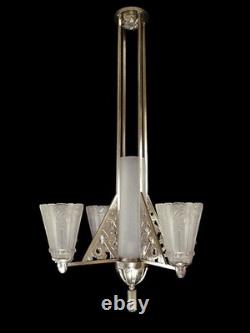
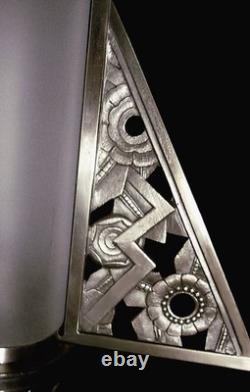
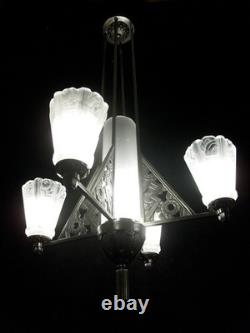
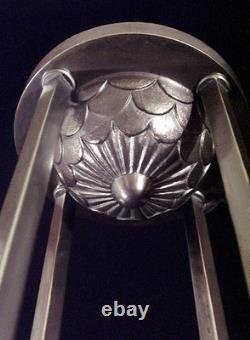
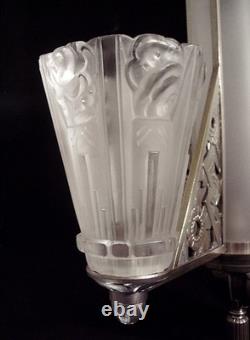
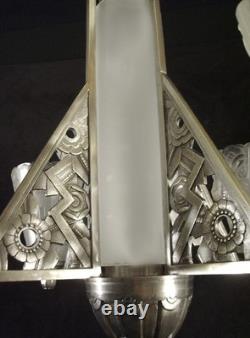
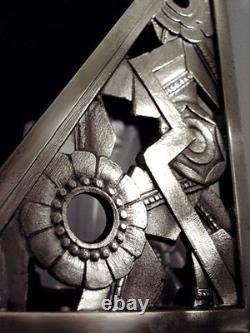
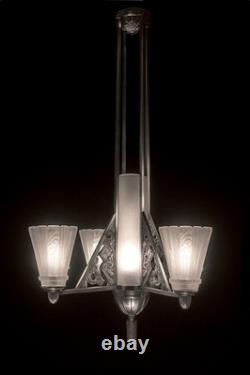

Very elegant Art Deco chandelier. Made of nickel-plated bronze and fitted with four peripheral molded-pressed glass tulip shades, produced by the Établissements Jean Gauthier, as well as a central frosted-glass shade. The frame bears no monogram or other mark that would identify the maker of this light fixture; the bronzier therefore remains unknown at this stage. However, because of the openwork decoration and overall shape, Georges Sontag may be considered as the possible author.
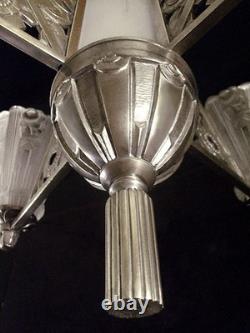
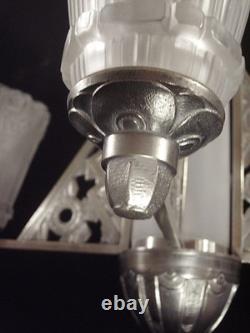
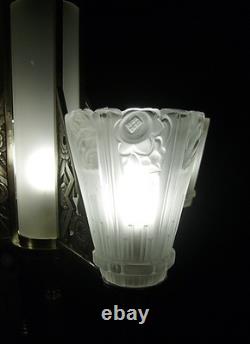
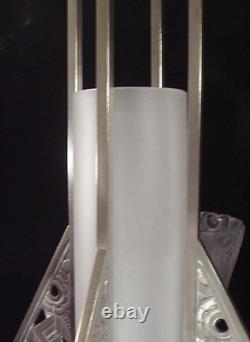
This chandelier, with perfect proportions, measures 86 cm in height, 50 cm in width, and weighs 6 kilos. Vertical, straight, and parallel lines, finely decorated with a stylized floral motif, are set around a central pyramidal structure. The sides are animated with stylized geometric and vegetal compositions. Four short cross-shaped arms support it. The lower part of the frame ends in a turned, fluted dome element, extended by a. The original nickel plating shows a few worn areas, but this does not detract from the overall aesthetic. Satin finish and translucent areas. Flared in a truncated cone shape, with a smooth upper rim, slightly wavy due to the succession of sections. The body is divided into six vertical facets clearly marked by fine raised ridges, creating a regular geometric rhythm. In the upper part of each facet, a strongly raised stylized floral motif, evoking a rose or peony in full bloom, is rendered in an Art Deco style with softened, rounded volumes.Beneath each flower, a slightly raised triangular decorative element, complemented by small geometric forms (chevron motifs), serves as a transition to the lower section. Long vertical recessed flutes, widening toward the bottom, multiply to form a radiating bundle, accentuating the effect of height and directed light. This tulip model, produced by the Établissements Jean Gauthier, exists in a signed version marked “J.
Robert” or in an unsigned version. Jean Gauthier founded his production and decorative ceramics and lighting glass company in Paris in 1909. During the 1920s and 1930s, the prolific Gauthier produced a large number of lighting glass pieces at his factory in Ézanville, in the Oise region.His models are sometimes unsigned, often marked EJG for Établissements Jean Gauthier or J. Robert, in reference to Jean Robert Street, where his decoration workshop was located. This glassworks was undoubtedly one of the most important before the war, alongside those of Degué and the Muller Brothers. A store located at number 13 on the famous Rue du Paradis also displayed Gauthier’s productions.
After the 1929 crisis, it was the same Jean Gauthier who produced lighting glass marked Ezan. The four tulip shades fitted to this chandelier are unsigned. They are in very good condition, though one of them has slight chips on the upper rim. They are not attached to the socket by a ring, but simply rest on the socket holder. To fit this support, the neck of these tulips has been slightly reduced. The central cylinder is also in good condition, with a few air bubbles trapped in the glass. This chandelier has been completely rewired with new wire; the sockets are made of brass. New LED bulbs will be supplied. Any total or partial reproduction of the text and/or images of this listing is strictly prohibited.